
How to make crepes for industrial foods production involves more than simply heating batter to shape it. It requires standardized ingredient preparation, mixing, and baking to ensure consistent output.
Industrial crepes production focuses on parameters such as crepe thickness, diameter, moisture content, color, and hourly output. Maintaining consistency in these areas is essential to meeting the demands of food factories, catering suppliers, and bulk sales markets.
Compared to manual preparation, industrial production enables a continuous workflow from batter preparation and automatic feeding to baking, cooling, and stacking. Therefore, when planning industrial crepes business, it is crucial to select the right equipment based on product specifications and target capacity.

How to Make Crepes with Industrial Machine
A complete crepe production process typically involves the coordinated operation of multiple pieces of equipment. First, ingredients such as flour, water, eggs, and fats are thoroughly mixed using a mixing unit to ensure a uniform batter consistency. The batter is then fed into a transfer and supply system, which delivers it steadily to the baking zone.
The batter is rapidly baked and set through continuous, even heating; temperature and timing can be adjusted to achieve the desired crepe color and thickness. After forming and demolding, the crepes are transported via conveyor belt to downstream equipment for counting, stacking, and packaging. This minimizes manual labor and enables a fully integrated industrial crepes production process.
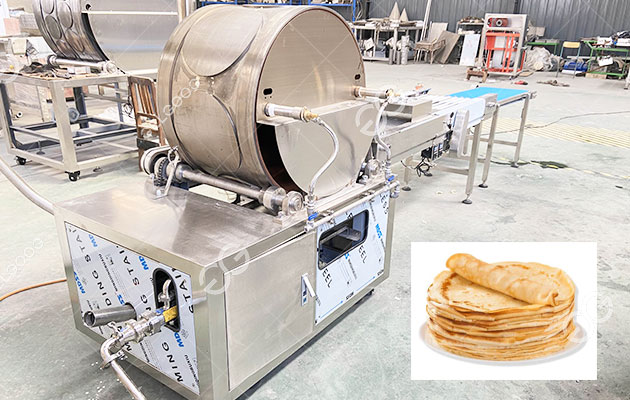
Advantages of Industrial Crepe Production
- Continuous automated production: Operations from batter feeding to baking, cooling, counting, and stacking run continuously, boosting production efficiency.
- Consistent product quality: Baking temperature, time, and feed volume are adjustable, ensuring uniformity in crepe thickness, diameter, and color.
- High production capacity: Maximum output reaches 10,000 crepes per hour, making it ideal for food factories, catering suppliers, and mass production scenarios.
- Reduced manual labor: Repetitive tasks like feeding, baking, cooling, and stacking are automated, lowering labor requirements.
- Ease of operation: Production parameters are set via a control system, simplifying production management and adjustments for operators.
- Adaptability to specifications: Parameters can be adjusted to meet specific customer requirements regarding crepe size, thickness, and baking results.
- Scalability: The core component is the baking unit; additional equipment for counting, stacking, and packaging can be integrated based on production needs.
Understanding the how to make crepes process reveals that consistent quality depends not only on raw materials and recipes but also on controlling the entire production workflow. A professional crepe production line enables the establishment of a stable and efficient industrial production system.
If you plan to expand capacity or launch a crepe business, please contact us to select the right automated production solution, a crucial step toward achieving stable production. Email: lisa@gelgoog.com, whatsapp: +15515571373.