
To launch a frozen spring roll business, you must first determine the product type, target market, and production scale, then configure processing equipment based on actual production capacity. For a frozen spring roll factory, factors such as product specifications, processing workflows, freezing methods, and packaging solutions will all impact final production efficiency and product quality.
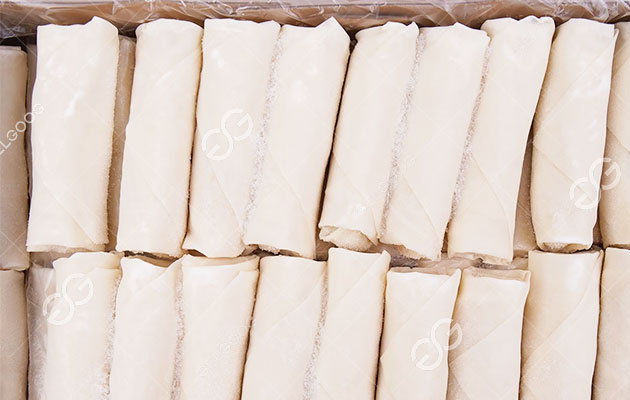
Defining the Market and Spring Roll Types
Before investing in production equipment, it is essential to clarify your target market and product positioning. Frozen spring rolls can be supplied to supermarkets, foodservice businesses, food wholesalers, and catering/distribution companies.
Common products include:
- Vegetable Spring Rolls: Featuring vegetables as the primary filling; suitable for both retail and foodservice markets.
- Chicken Spring Rolls: Combining chicken with vegetables; recipes can be adjusted to suit local tastes.
- Shrimp Spring Rolls: Suitable for foodservice and mid-to-high-end food markets.
- Mixed Filling Spring Rolls: Combinations of various fillings tailored to market demand.
- Rice Paper Spring Rolls: Using rice paper wrappers; fillings and packaging specifications can be adapted based on product positioning.
Additionally, determining the spring roll dimensions, unit weight, filling ratio, and packaging specifications will provide the necessary basis for subsequent equipment selection.
Understanding the Frozen Spring Roll Process
Standard frozen spring roll business typically involves steps such as raw material preparation, batter mixing, wrapper making, filling preparation, filling, folding and rolling, freezing, and packaging.
- Batter Preparation: Mix flour, water, and other ingredients according to the formula to create a uniform batter.
- Wrapper Making: Continuously produce spring roll wrappers using specialized equipment, while controlling the thickness and dimensions of the sheets.
- Filling Preparation: Cut, mix, and season vegetables, meat, or other fillings, while controlling particle size and moisture content.
- Filling & Forming: Deposit a measured amount of filling onto the wrapper and complete the folding and rolling process to ensure consistent product size and weight.
- Freezing: Subject the formed spring rolls to rapid freezing in freezing equipment to facilitate subsequent storage and transport.
- Packaging: Package the frozen products according to sales specifications and move them to cold storage.
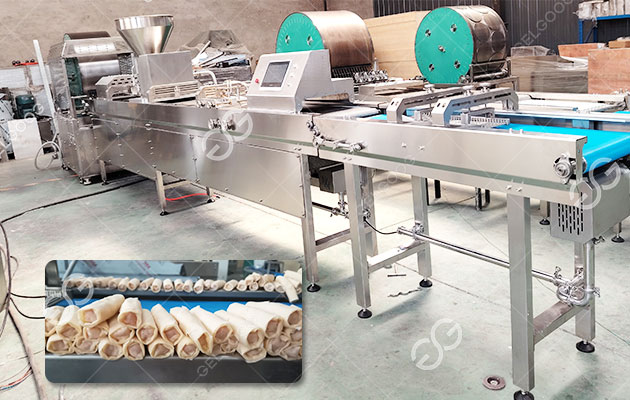
Planning Production Capacity for Frozen Spring Rolls
Equipment with varying production capacities can be selected based on order volumes and target markets. Our spring roll production equipment offers capacities ranging from 1,000 to 10,000 spring rolls per hour, catering to commercial production needs of various scales.
- 1,000–2,000 pcs/h: Suitable for initial commercial production, primarily targeting local foodservice, retail, and wholesale markets.
- 3,000–5,000 pcs/h: Suitable for medium-sized food enterprises with stable orders; enhances production efficiency and reduces manual labor.
- 6,000–10,000 pcs/h: Suitable for large-scale food factories and mass production; meets supply demands for supermarkets, food distributors, and major foodservice clients.
When selecting capacity, calculations should factor in product specifications, spring roll weight, daily operating hours, and projected order volumes, while also allowing for additional capacity to accommodate future market growth.
Planning for Spring Roll Freezing, Packaging, and Storage
Freezing, packaging, and storage are critical components of frozen spring roll production.
Key considerations include:
- Freezing Capacity: Aligning capacity with the forming stage to ensure timely freezing of the product.
- Packaging Specifications: Determining packaging details based on sales channels and product weight.
- Cold Storage: Planning storage capacity based on daily output and inventory cycles.
- Transportation: Organizing cold chain logistics based on target sales regions.
Therefore, a comprehensive frozen spring roll business plan must address not only production equipment but also the integrated planning of freezing, packaging, storage, and distribution. A well-designed equipment configuration ensures stable output while allowing room for future production expansion.